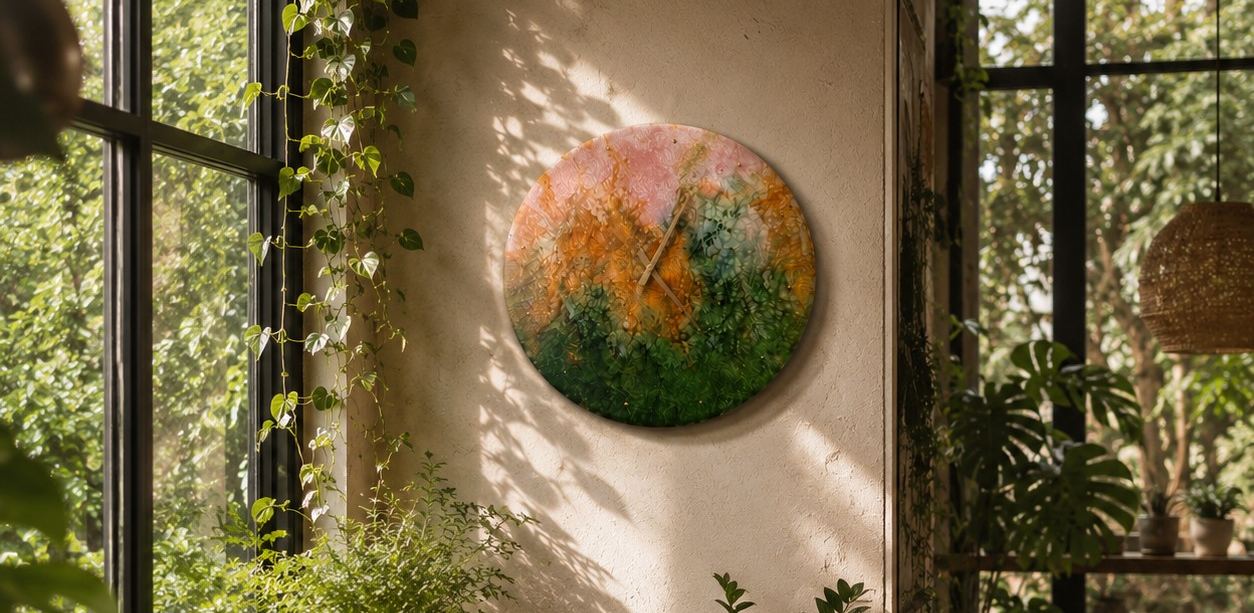
A wall clock is no longer just a tool for telling time. In contemporary interiors, it often serves as a decorative statement, a focal point, and an expression of personal style.
The right clock can enhance the character of a room, add elegance, or introduce a subtle artistic element. But how do you choose one that truly complements a modern interior?
- Start with Proportion
One of the most common mistakes is choosing a clock that is too small.
On a large wall, a small clock can easily disappear and feel like an afterthought. Modern interiors tend to benefit from larger pieces that intentionally contribute to the overall composition of the space.
For most living rooms, clocks between 35 and 60 cm (14–24 inches) in diameter work particularly well, depending on the size of the wall and surrounding furniture.
The more minimalist the room, the more impact a well-proportioned clock can have.
- Match the Material to the Interior Style
Modern interiors are increasingly moving away from perfectly smooth, industrial-looking surfaces.
Instead, designers are embracing materials with texture, depth, and a sense of craftsmanship.
Depending on your aesthetic, consider:
Wood for Scandinavian and Japandi-inspired spaces Metal for modern and industrial interiors Stone for natural, organic environments Artistic resin for a more sculptural and contemporary statement
The material should complement the surrounding décor without necessarily matching everything exactly.
- Colour Matters More Than You Think
Many people instinctively choose a black or white clock. While these are timeless options, they are not always the most interesting ones.
Today, designers often use wall clocks as subtle colour accents within a space.
Deep navy, rich violet, olive green, warm beige, or muted gold can add character without overwhelming the room.
The most harmonious result is usually achieved when the clock references one or two colours already present elsewhere in the interior.
- Decide How Decorative You Want It to Be
Not every wall clock needs to be the centrepiece of a room.
In modern interiors, there are generally two approaches:
Minimalist
Clean lines, understated colours, and simple forms.
Ideal for spaces where architecture, artwork, or furniture already take centre stage.
Artistic
Expressive shapes, distinctive textures, and unconventional designs.
These clocks function somewhere between a practical object and a piece of wall art.
- Consider Where It Will Be Displayed
The same clock can feel completely different depending on where it is placed.
Modern wall clocks are most commonly used:
Above a sofa in the living room Over a console table in the hallway In a dining area In a home office On a feature wall that needs a visual focal point
Before purchasing, try outlining the clock’s dimensions on the wall using masking tape. This simple trick makes it much easier to judge proportions and avoid costly mistakes.
Why Are Wall Clocks Popular Again?
Despite the convenience of smartphones and smart devices, many people are rediscovering the value of thoughtfully designed objects within their homes.
A wall clock is one of the few decorative pieces that combines function with visual impact. Beyond displaying the time, it helps define the atmosphere and personality of a space.
That is why contemporary wall clocks increasingly resemble pieces of functional art rather than purely practical household items.