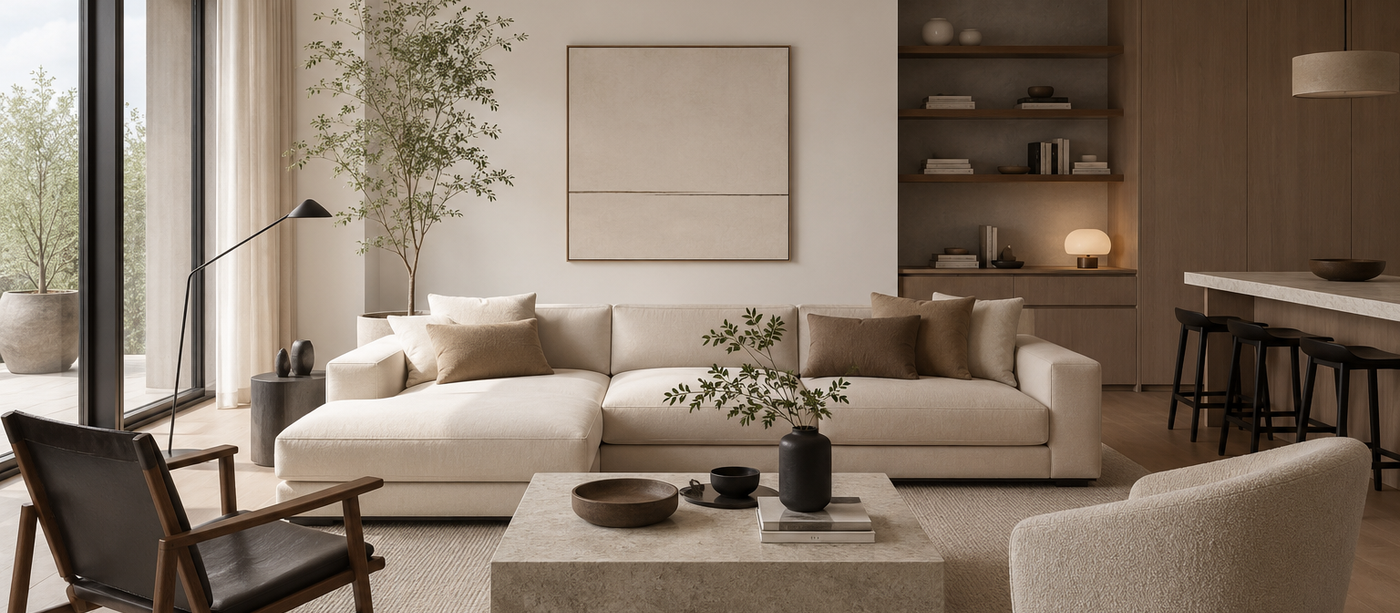
Modern Interior Design – A Complete Guide
Design Lens
Modern interior design was never meant to impress through excess. It was created to prove that well-designed spaces are beautiful on their own.
When people think about modern interiors, they often picture white walls, simple furniture and very few decorations. While those elements are common, they don't define the style. Modern interior design is not about removing as much as possible. It's about making thoughtful design decisions.
In a modern home, every material, colour and piece of furniture has a purpose. Nothing is added without a reason. This creates spaces that feel calm, functional and timeless rather than driven by short-lived trends.
That is why modern interior design has remained relevant for more than a century. Although its origins date back to the early twentieth century, the principles behind it continue to influence residential architecture and interior design today.
In this guide, you'll learn what defines modern interior design, how it differs from contemporary style, which materials and colours work best, and how to create a home that will still feel relevant years from now.
What Is Modern Interior Design?
Modern interior design emerged as a response to the heavily decorated interiors of the late nineteenth and early twentieth centuries. Designers began moving away from ornate furniture, elaborate mouldings and purely decorative details, focusing instead on function, proportion and craftsmanship.
This shift introduced a simple but powerful idea: form should follow function.
Instead of hiding materials beneath layers of decoration, designers chose to celebrate them.
Wood was allowed to look like wood.
Stone looked like stone.
Steel didn't need decorative finishes to feel elegant.
Those ideas continue to define modern interiors today.
Modern design doesn't aim to create cold or empty spaces. Quite the opposite. A well-designed modern living room can feel warm, comfortable and inviting. The atmosphere comes from carefully selected materials, balanced proportions and thoughtful lighting rather than an abundance of decorative objects.
Design Lens
Great interiors don't need many decorations. Their greatest strength lies in proportion, light and honest materials.
Modern vs Contemporary Interior Design
These two terms are often used interchangeably, but they describe different things.
Modern interior design refers to a specific design movement that emerged during the first half of the twentieth century. It follows a clear set of principles and has a well-defined visual language.
Contemporary interior design, on the other hand, reflects what is current today. It evolves as trends change, which means contemporary interiors may look very different ten years from now.
Understanding this distinction is important when planning your own home.
If your goal is to create an interior that won't feel dated after a few seasons, modern design offers a much stronger foundation than simply following current trends.
The Key Principles of Modern Interior Design
There isn't a checklist of furniture pieces that automatically creates a modern interior.
Instead, modern spaces are built around a few fundamental design principles.
Function Comes First
Every element should have a purpose.
Modern interiors are designed around the way people actually live. Furniture placement, circulation and storage are considered before decorative accessories are introduced.
Good design starts with solving practical problems.
Balance and Proportion
One of the least visible—but most important—qualities of a well-designed interior is proportion.
A rug that's too small, a pendant light that's undersized for the dining table or artwork hung too high can disrupt the entire composition.
Professional designers spend as much time considering relationships between objects as they do choosing the objects themselves.
Consistency
Modern interiors avoid visual noise.
If black metal is used in lighting fixtures, it's often repeated in cabinet handles or furniture frames. If oak becomes the primary wood species, it usually appears throughout the home instead of being mixed with several different finishes.
These subtle repetitions create harmony without making the space feel repetitive.
Space Matters
One of the most overlooked elements of modern design is empty space.
Not every wall needs a cabinet.
Not every surface needs decoration.
Leaving room between furniture allows the architecture to breathe and gives important pieces the attention they deserve.
Design Lens
A well-designed room never feels empty. It feels intentional.
Colour Palette
Modern interiors rely on calm, balanced colour palettes rather than bold contrasts.
Neutral tones provide a backdrop that allows materials, furniture and natural light to take centre stage.
The most common colours include:
- warm white,
- ivory,
- soft beige,
- sand,
- light grey,
- charcoal,
- natural wood tones.
Stronger colours can still be introduced, but they're usually used as accents rather than dominant features.
An olive-green armchair, a graphite sofa or a single artwork can add character without overwhelming the space.
In modern interior design, colour is rarely the focal point.
Instead, attention is drawn to texture, natural light and the relationship between carefully selected materials.
Design Lens
A balanced colour palette doesn't compete for attention. It allows the architecture and materials to speak for themselves.
Materials
Materials are one of the reasons why modern interiors age so well. They define the character of a space far more than decorative accessories or changing trends.
Rather than combining many different finishes, modern interiors usually rely on a carefully selected palette of materials that appears consistently throughout the home. This creates spaces that feel calm, balanced and visually connected.
Wood
Wood brings warmth and balance to modern interiors.
Oak, ash and walnut are among the most commonly used species, each offering its own character while remaining timeless. Instead of hiding the natural grain beneath heavy stains or high-gloss finishes, modern design embraces it.
The finish is just as important as the species itself. Oiled wood tends to look softer and more natural than heavily lacquered surfaces, allowing the texture and grain to remain visible.
Repeating the same type of wood in flooring, furniture and cabinetry creates continuity without making the space feel repetitive.
Stone
Stone introduces durability, texture and visual depth.
While marble remains a classic choice, designers increasingly use materials such as travertine, limestone and quartzite, which offer a quieter and more organic appearance.
Rather than covering multiple surfaces with stone, it's often used selectively—a kitchen island, a coffee table or a bathroom vanity is usually enough to make an impact.
Metal
Metal is rarely the main feature of a modern interior.
Instead, it appears in details such as table bases, shelving, lighting fixtures, cabinet handles or window frames.
Matte and brushed finishes generally feel more refined than highly polished surfaces because they reflect light more softly and don't dominate the space.
Textiles
Textiles are what make modern interiors comfortable.
Linen, wool, cotton and bouclé soften harder materials such as wood, concrete, glass and stone while adding subtle texture.
Rather than introducing bold patterns, modern interiors rely on differences in texture to create visual interest.
Design Lens
Great interiors don't rely on many materials. They rely on choosing the right ones.
Furniture
Furniture in a modern interior should first respond to everyday life.
Instead of asking which sofa is currently trending, modern design begins with a different question:
How will this room actually be used?
Comfort, proportion and quality always take priority over decoration.
Clean Forms
Modern furniture is characterised by clear, balanced shapes.
This doesn't mean every piece has to be perfectly rectangular. Contemporary interpretations of modern design often introduce softer silhouettes through curved sofas, rounded coffee tables or sculptural lounge chairs.
These organic forms help soften the architecture while maintaining the overall simplicity of the space.
Comfort Matters
Beautiful furniture that nobody enjoys using is simply poor design.
A sofa should encourage relaxation.
Dining chairs should remain comfortable during long meals.
Coffee tables should sit at the right height for everyday use.
Modern design has always prioritised functionality over appearance alone.
Scale
Choosing the right size is just as important as choosing the right style.
An oversized sectional can overwhelm a compact living room, while a coffee table that's too small may feel disconnected from the rest of the furniture.
Professional designers always consider how individual pieces relate to the room as a whole rather than evaluating each object separately.
Leave Room to Breathe
One of the easiest mistakes is adding too much furniture.
Modern interiors feel spacious because they allow room between objects.
Empty space isn't wasted space—it helps architecture, furniture and natural light stand out.
Design Lens
Good furniture doesn't need to dominate a room. It simply belongs there.
Lighting
Light is one of the most powerful design tools in a modern interior.
During the day, natural light highlights textures, colours and materials.
In the evening, artificial lighting takes over, shaping the atmosphere of the space.
Rather than relying on a single ceiling fixture, modern interiors combine multiple light sources.
These typically include:
- ambient lighting,
- table lamps,
- floor lamps,
- wall lights,
- accent lighting.
Layering light allows the room to adapt throughout the day while making it feel warmer and more inviting.
Colour Temperature
For living rooms, bedrooms and dining spaces, warm light between 2700 K and 3000 K usually creates the most comfortable atmosphere.
It enhances the appearance of wood, softens shadows and makes natural materials feel richer.
Cool white lighting often works better in utility rooms or workspaces than in living areas.
Lighting as Design
Modern lighting isn't purely functional.
A well-designed lamp can become a sculptural object even when it's switched off.
This is why handcrafted lighting, organic forms and carefully selected materials have become increasingly important in contemporary interpretations of modern interiors.
Decorative Objects
Decorative objects are never the starting point of a modern interior.
They come last.
Their role isn't to fill empty shelves or hide unfinished spaces. Instead, they complete the overall composition.
Rather than displaying many small accessories, modern interiors often feature just a few carefully chosen pieces.
These might include:
- handcrafted ceramic vases,
- decorative trays,
- sculptural lamps,
- stone bowls,
- books,
- artwork,
- candles.
The empty space around each object is just as important as the object itself.
Allowing decorative pieces room to breathe makes them feel intentional instead of cluttered.
Design Lens
The best decorative objects don't compete for attention. They quietly complete the room.
Common Mistakes
Modern interiors often look effortless, but achieving that balance requires careful decision-making. Most mistakes happen when individual elements are chosen without considering how they work together.
Mixing Too Many Materials
Combining several wood species, multiple stone finishes and different metal colours in the same room quickly creates visual noise.
A more successful approach is to choose a limited palette of materials and repeat them consistently throughout the space.
Filling Every Surface
Modern interiors don't need decorations everywhere.
Open shelving, coffee tables and sideboards don't have to be filled completely. Leaving some empty space allows carefully selected objects to stand out and gives the room a calmer appearance.
Buying Everything as a Set
Furniture collections make shopping easier, but they often make a home feel like a showroom.
Mixing pieces from different manufacturers usually creates a more natural and personal interior. The key is maintaining consistency in materials, proportions and colour rather than matching every item perfectly.
Ignoring Scale
Even beautiful furniture can feel out of place when its proportions are wrong.
A rug that's too small, oversized artwork above a narrow console or tiny pendant lights above a large dining table can disrupt the balance of the room.
Before buying furniture or lighting, always consider how each piece relates to the surrounding space.
Choosing the Wrong Lighting
Lighting has a significant impact on how materials are perceived.
Cool white light often makes wood appear dull and interiors feel less inviting. Warm lighting generally creates a softer atmosphere and highlights the natural texture of materials much more effectively.
Design Lens
Timeless interiors aren't created by following trends. They're created by making thoughtful decisions.
Creating a Modern Interior on a Budget
One of the biggest advantages of modern interior design is that it doesn't require completing everything at once.
A well-designed home can evolve gradually.
Instead of replacing every piece of furniture, focus on building a strong foundation first.
Choose a calm colour palette, invest in comfortable furniture and use natural materials whenever possible.
Decorative accessories can always be added later.
If you're updating an existing interior, small changes often make the biggest difference.
Consider:
- replacing cool lighting with warm light,
- reducing the number of decorative objects,
- introducing natural textiles such as linen or wool,
- adding one larger piece of artwork instead of several smaller ones,
- organising open shelves,
- replacing low-quality accessories with a few carefully selected objects.
Modern interiors rarely become better by adding more.
Most improvements come from removing distractions.
How Decorative Objects Complete a Modern Interior
Decorative objects are often the final layer of a modern interior.
Their purpose isn't to fill empty spaces but to reinforce the atmosphere of the room.
Materials, craftsmanship and form become more important than quantity.
A handcrafted ceramic vase, a sculptural lamp, a decorative resin tray or a stone bowl can easily become a focal point without overwhelming the space.
Rather than placing many decorative objects throughout a room, it's often more effective to create one carefully arranged composition on a coffee table, console or shelving unit.
The empty space around each object is part of the composition itself.
This is what gives modern interiors their sense of calm and balance.
Design Lens
Beautiful interiors aren't remembered because they contain more objects. They're remembered because every object feels like it belongs.
Frequently Asked Questions
Is modern interior design the same as minimalist design?
No.
Minimalism focuses on reducing the number of objects to the absolute minimum. Modern interior design focuses on function, proportion and quality. Decorative objects are welcome as long as they contribute to the overall composition.
What colours work best in a modern interior?
Warm whites, soft beiges, light greys, charcoal and natural wood tones create a timeless foundation. Stronger colours are usually introduced only as accents.
What type of wood suits modern interiors?
Oak, ash and walnut are among the most popular choices because of their natural appearance and durability. The finish is equally important—oiled surfaces generally look more natural than high-gloss lacquer.
Can modern interior design work in a small apartment?
Yes.
Simple forms, thoughtful storage and a restrained colour palette often make smaller spaces feel larger and more organised.
Can modern interior design be combined with other styles?
Absolutely.
Modern interiors work particularly well with Scandinavian, Japandi and Organic Modern styles because they share similar principles of simplicity, functionality and natural materials.
Does a modern interior have to be white?
No.
While light colours are common, modern interiors also use warm beiges, olive green, charcoal and darker wood tones. The key is maintaining a balanced and cohesive palette rather than relying on a single colour.
Are decorative objects important in modern interiors?
Yes.
Modern interiors are not undecorated interiors. The difference lies in choosing fewer, higher-quality objects that complement the space instead of competing for attention.