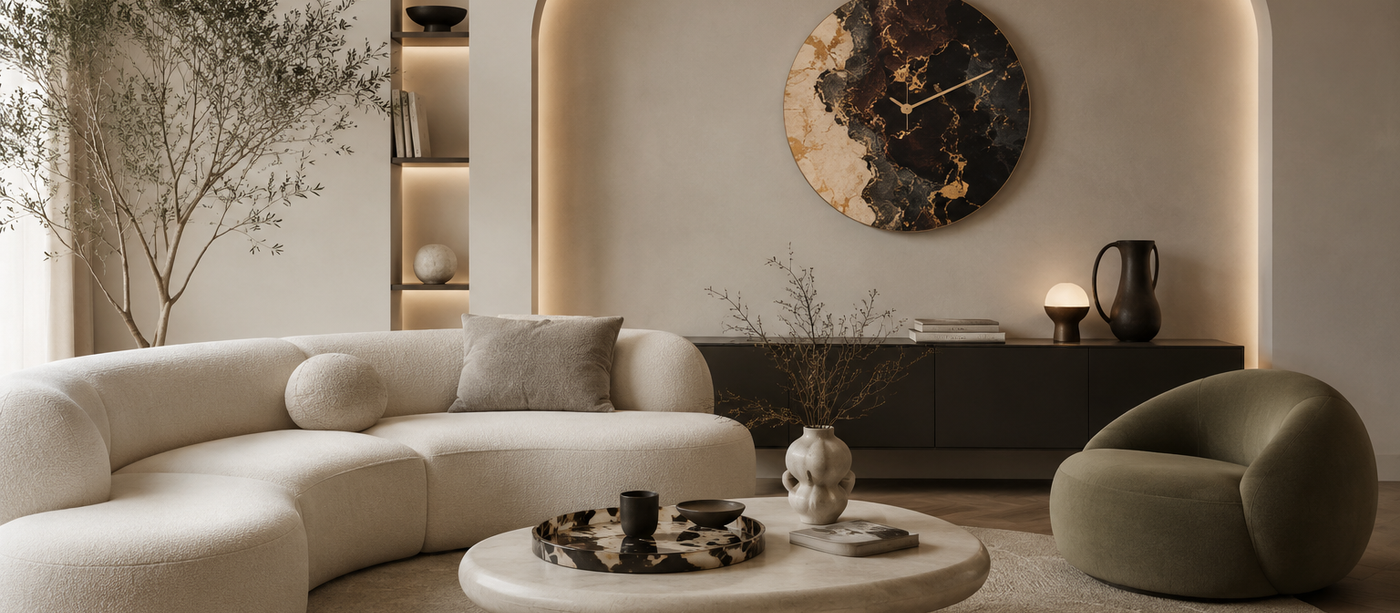
For many years, modern interior design was defined by clean lines, sharp angles, and geometric minimalism. While this aesthetic remains popular, we are increasingly seeing a shift toward softer, more organic forms.
Curved sofas, oval mirrors, sculptural lighting, and biomorphic decorative objects are now appearing in luxury interiors and contemporary homes alike. These shapes bring warmth, character, and a sense of balance to spaces that might otherwise feel overly structured.
But why have curves become such an important part of modern design?
Our Brains Naturally Prefer Soft Shapes
This trend is not simply about aesthetics.
Research suggests that people instinctively perceive rounded forms as more welcoming and approachable than sharp angles. Curves are often associated with comfort, safety, and natural movement, while aggressive lines can create subtle feelings of tension.
As a result, interiors that incorporate softer shapes often feel calmer, more harmonious, and more inviting.
Nature Rarely Creates Perfect Straight Lines
Look closely at the natural world.
From weathered stones and ocean waves to flower petals and cloud formations, nature is filled with flowing, organic shapes rather than perfect geometry.
It is no surprise that designers increasingly draw inspiration from these forms. Organic silhouettes bring a sense of ease and authenticity into a space, even when the overall aesthetic remains modern and minimal.
Curves Balance Contemporary Lifestyles
Most of us spend a significant portion of our day surrounded by screens.
Computers, televisions, tablets, and smartphones introduce countless rectangles into our visual environment. Architecture often reinforces this pattern through square rooms, doors, windows, and furniture.
Curved forms help break that repetition.
Introducing softer shapes into an interior can create a more balanced visual experience and make a space feel less rigid or overly technical.
Organic Forms Add Character
Minimalism continues to influence modern interiors, but many homeowners are looking for ways to create spaces that feel more personal and distinctive.
This is where sculptural, organic objects come into play.
An irregular wall clock, a decorative tray with a flowing silhouette, or a lamp inspired by natural forms can become a subtle focal point that adds individuality without overwhelming the room.
These pieces create visual interest while maintaining a sense of refinement.
Curves Do Not Need to Dominate a Space
Many people assume that embracing organic design requires a complete redesign.
In reality, even a few carefully chosen pieces can make a significant difference.
Consider introducing:
A round or irregular wall clock A decorative tray with a soft silhouette An oval mirror A curved coffee table A sculptural lamp inspired by natural forms
Sometimes a single object is enough to soften a room and create a more welcoming atmosphere.
The Future of Design Is More Organic
Today's interior trends increasingly combine minimalism with influences drawn from nature.
Rather than choosing between contemporary design and comfort, designers are finding ways to bring both together. Organic forms, gentle curves, and biomorphic shapes help create interiors that feel sophisticated while remaining warm and human.
Perhaps that is why we are gradually moving away from perfect geometry and embracing objects that resemble small pieces of sculpture or forms found in the natural world.
The result is a new kind of modern interior—one that feels elegant, timeless, and effortlessly connected to nature.